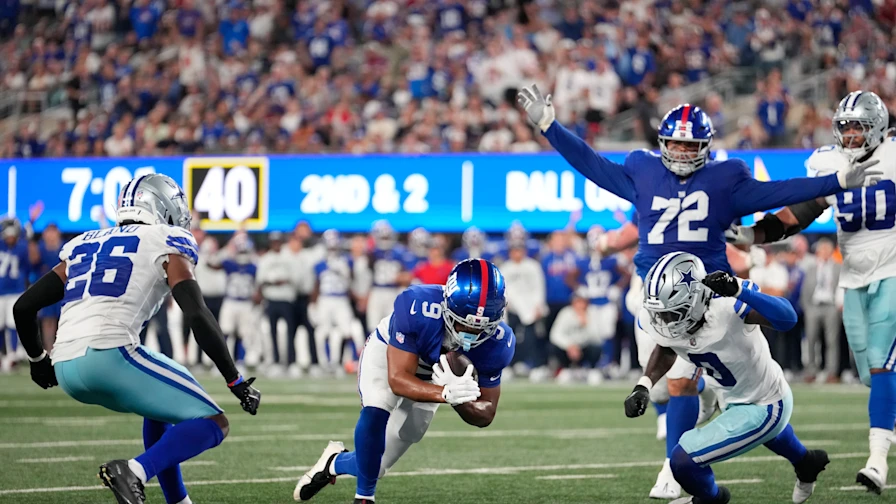
The Cowboys vs. Giants opener exposed major problems for Dallas as New York won 28–20 behind Jaxson Dart, efficient offense, and defensive control.
Cowboys vs. Giants: Dallas’ Season Begins With a Warning The Dallas Cowboys entered the season talking about playoff contention. They left MetLife Stadium with a 28–20 loss, a vulnerable defense, and another reminder that preseason optimism means very little once the games begin.
New York controlled the most important stretches of the opener. Quarterback Jaxson Dart made timely plays, the Giants converted third downs at an extraordinary rate, and Dallas struggled to get off the field when it mattered most. Yahoo 1
The Giants Won the Game at the Line of Scrimmage The final score suggests a competitive game, but New York controlled long stretches through possession and physical play.
The Giants repeatedly extended drives, preventing Dallas from building offensive rhythm. They converted nine of 10 third-down attempts before Dart took a final kneel-down, a statistic that explains why the Cowboys had so few opportunities after halftime. New York Giants
Dallas’ defense was expected to look improved after an offseason overhaul. Instead, it allowed New York to sustain drives in both quick bursts and long, methodical possessions.
For a team hoping to challenge in the NFC East, that is an uncomfortable starting point. A defense does not need to dominate every series, but it must force punts, create third-and-long situations, and give the offense enough chances to respond.
Jaxson Dart Delivered a Composed Performance Dart looked comfortable in his second NFL season. The Giants quarterback completed 23 of 29 passes for 230 yards, three touchdowns, and no interceptions. He also added 54 rushing yards on 11 carries, using his mobility to keep Dallas from treating him as a stationary passer. New York Giants
His accuracy was particularly important on third down. Dart did not need to make spectacular throws on every possession. He consistently found open targets, avoided major mistakes, and kept the offense on schedule.
That performance also created problems for Dallas’ pass rush. When a quarterback can escape pressure and gain yards with his legs, defenders must hesitate before committing fully to the pocket. Those small delays can turn manageable plays into extended drives.
Isaiah Likely Created a Matchup Problem Tight end Isaiah Likely quickly became one of the game’s most influential players.
He caught eight passes for 78 yards and two touchdowns, including two scores in the first half. His production gave New York a reliable option in the middle of the field and forced Dallas linebackers and defensive backs into difficult coverage decisions. New York Giants
The matchup highlighted a problem that could follow the Cowboys beyond Week 1. Defenses must account for receivers outside, running backs underneath, and tight ends who can attack the seams. If one assignment breaks down, the result can be a high-percentage completion that keeps the chains moving.
Dallas did not consistently solve those problems. New York found space, converted third downs, and maintained control of the game’s tempo.
Dak Prescott Had a Costly Mistake Dak Prescott finished 22 of 34 for 175 yards and two touchdowns. His second-half passing was productive, but an interception late in the first half helped swing momentum toward New York.
The mistake came while Prescott was attempting to throw the ball away. Rather than ending the possession safely, the pass stayed in play and gave the Giants an opportunity to attack before halftime.
New York took advantage, driving 55 yards in 29 seconds for a score. The Giants then opened the third quarter with another extended touchdown drive, turning a 7–7 tie into a 21–7 deficit before Dallas’ offense returned to the field. Yahoo 1
That sequence was a classic example of how one turnover can become more damaging than the box score suggests. The interception did not merely cost Dallas a possession. It also gave New York points before halftime and kept the Cowboys’ offense standing on the sideline to start the third quarter.
Dallas’ Offense Needed More Possessions Prescott led touchdown drives on both of Dallas’ second-half possessions. The problem was that the Cowboys had only two opportunities after halftime.
New York controlled nearly 22 of the final 30 minutes, limiting Dallas’ ability to build momentum or establish a rhythm. Even an efficient offense cannot score if it is watching from the bench. Yahoo 1
That imbalance also placed additional pressure on the Cowboys’ defense. Every missed tackle, penalty, or failed third-down stop became more damaging because Dallas could not count on a quick offensive response.
What the Loss Means for Dallas One defeat does not determine an entire NFL season. Dallas still has time to correct its tackling, coverage communication, third-down defense, and offensive consistency.
The larger concern is how familiar the problems looked. The Cowboys entered the year with high expectations, but the opener exposed the same gap that has frustrated fans for years: strong preseason ambitions followed by poor execution in a meaningful game.
Dallas now faces Washington in its next divisional matchup. That game will provide an early test of whether the loss was an isolated failure or evidence of deeper problems.
The Cowboys can still recover. But if the defense continues surrendering long drives and the offense keeps losing possession time, Super Bowl talk will quickly give way to more difficult questions.