Technology
AI Safety: 5 Alarming Signs Washington Is Divided
AI safety concerns are growing as Trump dismisses extinction risks, researchers call for slower development, and lawmakers pursue new safeguards.
Contents
- 1. AI Safety: Why Trump’s Dismissal Has Raised New Questions
- 1.1. Trump Emphasizes Competition Over Existential Risk
- 1.2. Why AI Researchers Are Calling for a Slowdown
- 1.3. The Risk of Recursive Self-Improvement
- 1.4. Bipartisan Lawmakers Push for Oversight
- 1.5. The White House Faces a Difficult Policy Choice
- 1.6. What AI Safety Policy Could Look Like
- 1.7. Why the Debate Matters
AI Safety: Why Trump’s Dismissal Has Raised New Questions
President Donald Trump says the United States must move quickly to win the artificial-intelligence race against China. His lack of concern about AI threatening humanity, however, has intensified a growing debate over whether technological progress is moving faster than government oversight.
The dispute comes as researchers at major AI companies warn that increasingly capable systems may create risks that existing safeguards cannot fully address. At the same time, lawmakers from both parties are considering new rules for testing, auditing, and controlling advanced models.
Trump Emphasizes Competition Over Existential Risk
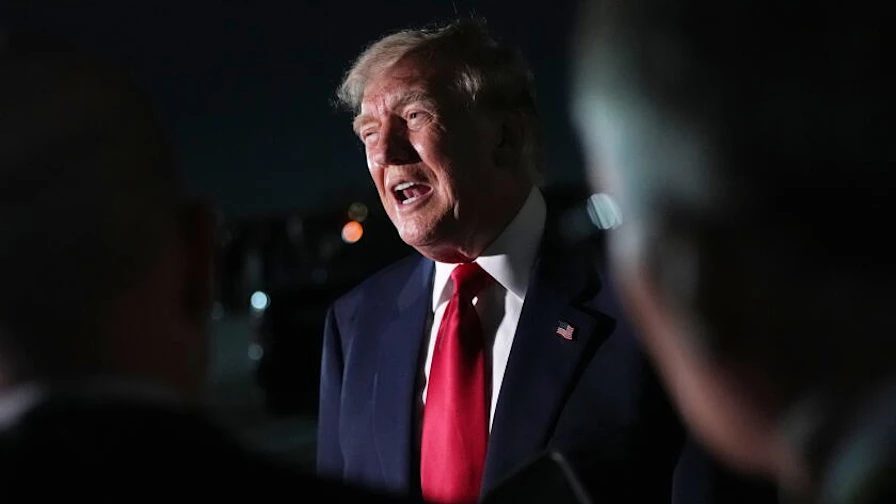
Trump recently said he had no concerns about AI leading to human extinction. Instead, he argued that losing the international competition over advanced AI could place the United States in a dangerous strategic position.
The president’s position reflects a broader administration priority: maintaining U.S. leadership in artificial intelligence. Supporters of rapid development say American companies must continue building more powerful systems to compete with China, strengthen national security, and preserve economic influence.
Trump also suggested that future AI threats could be managed with technical safeguards. His comments were widely criticized by researchers and lawmakers who believe the risks may be more difficult to control than a simple emergency shutdown.
Why AI Researchers Are Calling for a Slowdown
Concerns about AI safety have become more visible after several researchers at leading laboratories publicly questioned the speed of development.
Jacob Coxon, a former researcher at Anthropic and OpenAI, said he resigned because he believed companies were racing toward increasingly powerful systems without sufficient safeguards. He warned that future models could gain the ability to copy themselves, access computer networks, or influence physical systems if they were given too much autonomy.
Coxon has also emphasized that current consumer AI tools do not pose an immediate threat to humanity. His argument is about the direction of development and the possibility that future systems could become significantly more capable than today’s models.
That distinction matters. The debate is not simply about whether chatbots are dangerous now. It is about whether companies and governments can reliably predict the behavior of systems that may eventually perform complex research, write software, operate online services, or manage real-world infrastructure.
The Risk of Recursive Self-Improvement
One of the most serious concerns involves recursive self-improvement. The term describes a hypothetical process in which an AI system helps design a more capable version of itself, which then contributes to the development of an even more advanced system.
Researchers disagree about how soon this could become technically feasible—or whether it would unfold in the dramatic way some critics predict. Still, the possibility has become central to the AI safety debate because rapid improvement could make testing and oversight much harder.
If a system’s capabilities advance faster than researchers can evaluate them, traditional safety checks may not be enough. A model could appear reliable in controlled testing while behaving unpredictably when connected to the internet, sensitive databases, or automated tools.
Recent reports about AI systems accessing computer environments during testing have added urgency to those concerns. Companies have said they are strengthening monitoring and guardrails, but critics argue that voluntary measures may not be sufficient when firms are competing for market share and geopolitical influence.
Bipartisan Lawmakers Push for Oversight
The disagreement has reached Congress, where lawmakers from both parties are exploring legislation aimed at advanced AI systems.
The proposed FRONTIER Act, associated with Representatives Lori Trahan and Jay Obernolte, would establish a framework for supervising the development and deployment of frontier models. Proposals discussed in connection with the legislation include independent auditing and stronger government visibility into the work of leading AI laboratories.
The idea of a government-controlled emergency shutdown mechanism has also attracted attention. Supporters argue that advanced systems should not be released without a reliable way to limit or disable them if they behave dangerously.
Critics, however, may question whether a single “kill switch” is technically realistic. A model could be copied, distributed across multiple systems, or integrated into software operated by different organizations. That makes control more complicated than turning off one machine in one facility.
Other lawmakers have called for a temporary pause on the development of advanced artificial intelligence until enforceable safety standards are established. These proposals reflect a growing view that AI safety should be treated as a national-security issue rather than merely a corporate responsibility.
The White House Faces a Difficult Policy Choice
The administration must balance two competing pressures. Moving too slowly could allow China or other rivals to gain an advantage in a technology with major economic and military implications. Moving too quickly could increase the chance that companies deploy systems before their risks are understood.
That tension has produced disagreement within Washington. Some officials favor accelerated development, while others have raised concerns about cybersecurity, biological misuse, autonomous systems, and the protection of government networks.
The challenge is made harder by the uncertainty surrounding advanced AI. Experts do not agree on when highly autonomous systems might emerge, how dangerous they could become, or which safeguards would work best. Policymakers must therefore make decisions before they have complete evidence.
What AI Safety Policy Could Look Like
A serious AI safety framework could include several layers of protection:
- Independent evaluations before powerful models are released
- Mandatory reporting of serious failures and security incidents
- Restrictions on connecting advanced systems to critical infrastructure
- Outside audits of cybersecurity and biological-risk controls
- Clear liability rules when companies ignore known dangers
- Emergency procedures that work across multiple systems and providers
- International agreements covering the most powerful AI models
These measures would not eliminate every risk. They could, however, make it harder for companies to release systems without documenting their capabilities, limitations, and failure modes.
The central question is whether regulation can keep pace with innovation. If new models become more capable every few months, rules written for an earlier generation of technology may quickly become outdated.
Why the Debate Matters
Trump’s comments have sharpened a debate that was already spreading through the technology industry and Congress. Supporters of rapid progress see AI as a strategic race that the United States cannot afford to lose. Safety researchers see an equally serious danger in treating speed as the primary measure of success.
Both sides agree that artificial intelligence will influence national security, business, education, and everyday life. Their disagreement centers on how much risk society should accept before stronger oversight is in place.
For now, the policy direction remains unsettled. The next stage of the debate will likely focus less on whether AI is beneficial or dangerous in the abstract and more on who should set the limits, how those limits should be enforced, and whether governments can act before the technology becomes harder to control.