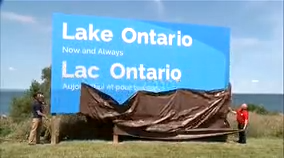
A new Lake Ontario sign says “Now and Always” after Trump ordered the lake renamed Lake America. Here’s what the dispute means for Canada and the U.S.
Ontario has installed a giant blue Lake Ontario sign along the Canadian shoreline after President Donald Trump ordered the body of water renamed “Lake America” in the United States. The province’s message is direct: Canadians will continue calling it Lake Ontario.
Why Ontario Installed the Lake Ontario Sign
Ontario Premier Doug Ford unveiled the sign Saturday at Fifty Point Conservation Area in Grimsby, near Hamilton. It reads “Lake Ontario—Now and Always” in English and “Lac Ontario—Aujourd’hui et pour toujours” in French.
Ford said the display was created to remind Trump and the public that the lake’s established name would remain unchanged in Canada. He argued that the lake existed under the name Lake Ontario long before Trump entered office and would continue to carry that name afterward. Yahoo
The Lake Ontario sign is both a political statement and a symbolic defense of Canadian identity. Rather than issuing only a written response, Ontario placed its message beside the water itself.
Ford’s Message to Washington
Ford said Trump’s decision appeared connected to broader disagreements with Ontario and Canada, including trade and sovereignty disputes.
The premier also urged both countries to lower the temperature and negotiate a fair agreement. His response combined sharp criticism with a recognition that the escalating conflict was damaging businesses and workers on both sides of the border.
What Trump’s Executive Order Does
Trump signed an executive order directing the United States to recognize Lake Ontario as “Lake America.” The order gives the U.S. Department of the Interior 30 days to update the Geographic Names Information Service, the federal repository for U.S. geographic names. Yahoo
That action can affect how the lake is labeled in U.S. federal documents and government systems. It does not automatically force Canada, New York, international organizations, or private companies in other countries to adopt the new name.
The lake is shared by Ontario and New York. Because it crosses an international boundary, one government’s preferred name cannot simply erase the terminology used by the other country.
Canada Does Not Have to Use the New Name
Canadian officials have rejected the proposed renaming. Industry Minister Mélanie Joly said Canadians would continue calling the lake Lake Ontario, while Prime Minister Mark Carney also defended the traditional name. Yahoo
The Lake Ontario sign reflects that position. It is not a legal renaming of the lake; it is a public declaration that Ontario will not recognize the U.S. change.
Other countries and institutions may also choose to use the long-established name. Digital mapping companies could potentially display different labels depending on a user’s location, as has happened during previous disputes involving renamed geographic features.
The Indigenous History Behind the Name
The name Ontario comes from an Iroquoian word commonly translated as “lake of shining waters.” The name predates the creation of both Canada and the United States. Yahoo
That history has added another dimension to the controversy. The Seneca Nation criticized Trump’s order and argued that the U.S. president cannot erase or claim ownership of Indigenous culture through a political directive.
J. Conrad Seneca, president of the Seneca Nation, said the name should remain as a reflection of Indigenous communities that lived around the lake long before the modern borders of Canada and the United States were established. Yahoo
Why the Name Matters
Geographic names often carry historical, cultural, and political meaning. In this case, Lake Ontario is connected to:
- Indigenous history
- The Great Lakes region
- Canadian provincial identity
- U.S.–Canada transportation and trade
- Communities on both sides of the border
- Long-standing maps, treaties, and public records
The Lake Ontario sign draws attention to that wider history rather than treating the dispute as a simple naming disagreement.
The Renaming Fight Comes During a Trade War
The lake dispute emerged as relations between Washington and Ottawa deteriorated.
The United States imposed 50% tariffs on a range of Canadian products, including Canadian steel and aluminum. Canada announced retaliatory measures designed to match American tariffs on selected U.S. goods.
The two governments have also exchanged increasingly aggressive statements. Ford accused Trump of attacking Canadian sovereignty, while Trump criticized Ford and Canadian Prime Minister Mark Carney.
Against that backdrop, the Lake Ontario sign has become part of a much larger political conflict involving tariffs, national identity, and the future of the bilateral relationship.
A Symbolic Response With Limited Legal Effect
The sign is unlikely to change American federal documents or the U.S. government’s official terminology. Its purpose is primarily communicative.
Ontario is telling residents, visitors, and the American public that its government will continue using the traditional name. The message is easy to understand, highly visible, and designed for news coverage and social media.
That makes the Lake Ontario sign an effective piece of political messaging even though it does not alter the lake’s legal status or geographic boundaries.
Could the Lake Have Two Names?
It is possible that the United States and Canada will use different names in their own official systems.
A similar pattern emerged after Trump ordered the Gulf of Mexico renamed “Gulf of America” in U.S. federal usage. Mexico rejected that change, and digital map services used different labels depending on the viewer’s location. Yahoo
The same situation could develop with Lake Ontario. U.S. government agencies may use “Lake America,” while Canadian authorities continue with “Lake Ontario.” International organizations and businesses may decide which name to use based on established standards or regional conventions.
For people living around the lake, everyday usage is likely to remain more important than a federal database entry. Residents in Ontario and New York have used Lake Ontario for generations.
What the Lake Ontario Sign Represents
The Lake Ontario sign represents several ideas at once.
First, it rejects the notion that one country can unilaterally redefine a shared body of water for everyone else. Second, it emphasizes the lake’s Indigenous and Canadian history. Third, it gives Ontario a highly visible way to respond during a tense period with Washington.
The sign also reflects a familiar Canadian style of political communication: firm opposition delivered through symbolism, humor, and public displays rather than through military or economic escalation.
For Ford, the installation reinforces his position as a defender of Ontario’s interests. For Canadian officials more broadly, it supports the argument that the name dispute is connected to national sovereignty.
What Happens Next?
The U.S. Department of the Interior is expected to process the executive order within the required period. Canadian officials are expected to continue using Lake Ontario.
The dispute may produce further disagreements involving:
- Government maps
- Weather and shipping reports
- International databases
- Digital mapping platforms
- Educational materials
- Navigation and transportation records
- Tourism and marketing campaigns
The Lake Ontario sign may remain in place as a public reminder of Ontario’s position, regardless of what appears in U.S. federal systems.
Final Takeaway
Ontario installed the Lake Ontario sign after President Trump ordered the lake renamed Lake America in the United States. The blue display, placed near Hamilton, declares that the province will continue calling it Lake Ontario “now and always.”
The disagreement has little immediate effect on the waterway itself, but it carries significant political and cultural meaning. It touches on Indigenous history, Canadian sovereignty, U.S.–Canada trade tensions, and the limits of one country’s authority over a shared international landmark.
For Ontario officials, the answer is clear: the lake’s name remains Lake Ontario.