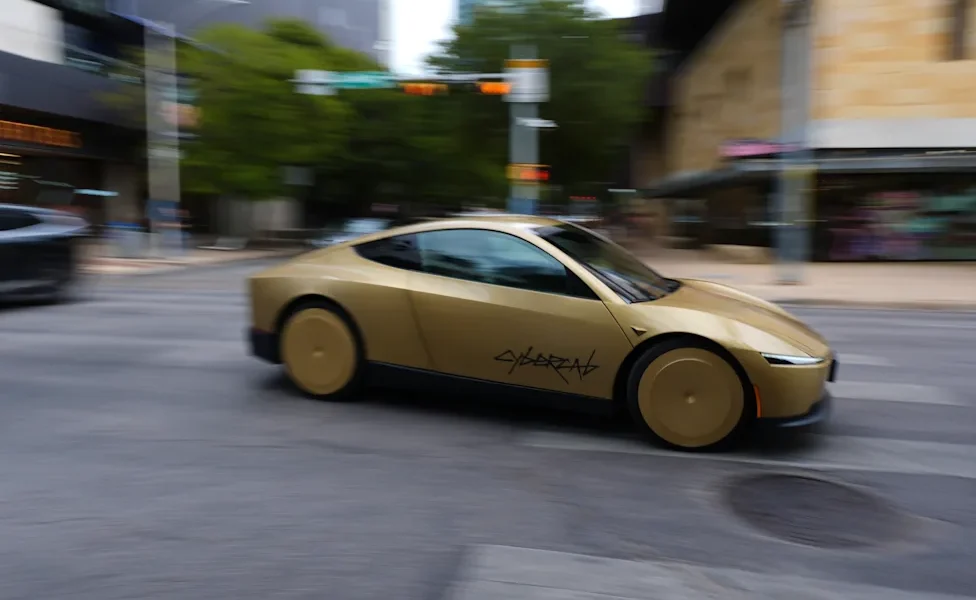
Tesla Cybercab Investigation Begins After Austin Launch
Federal regulators have opened an investigation into Tesla’s new Cybercab robotaxi, just one day after the company began offering rides in the steering-wheel-free vehicles in Austin, Texas.
The National Highway Traffic Safety Administration is examining whether the Cybercab complies with federal vehicle-safety requirements. The two-seat vehicle does not include a steering wheel, traditional mirrors, or brake pedals—equipment typically found in passenger cars.
The investigation creates an immediate regulatory challenge for Tesla as CEO Elon Musk promotes the Cybercab as the foundation of a nationwide driverless taxi service.
Why Is the Cybercab Under Investigation?
NHTSA said it would review whether Tesla properly certified the Cybercab before deploying it on public roads.
Tesla has said it used a self-certification process to determine that the vehicle met federal requirements. Under that system, manufacturers are responsible for assessing whether their vehicles comply with applicable safety standards.
The agency now plans to audit the process and technical data Tesla used to support that certification.
The investigation does not establish that the Cybercab violated federal law. It means regulators are seeking more information about how Tesla determined that a vehicle without manual driving controls met the necessary safety requirements.
What Makes the Tesla Cybercab Different?
The Cybercab is designed to operate without a human driver. It has no steering wheel or brake pedals for a passenger to use in an emergency.
That design distinguishes it from Tesla’s existing vehicles, which include systems that assist a human driver but retain conventional controls. The Cybercab is intended to operate as a fully autonomous taxi rather than a privately owned vehicle that requires a driver to remain ready to take over.
The car also lacks traditional side mirrors, according to the regulatory filing. Tesla is relying on cameras, sensors, software, and automated driving systems to handle navigation and safety tasks.
Its compact, two-seat layout is aimed at short urban trips and ride-hailing use. Tesla’s broader plan is to operate Cybercabs alongside its existing robotaxi service, which has previously used modified versions of standard Tesla vehicles.
How Did Tesla Launch the Austin Service?
Musk introduced the Cybercab service in Austin on Thursday, September 3, 2026. Tesla sent dozens of the vehicles onto city streets and held a launch event for invited guests.
The Austin program is expected to serve as an early test of Tesla’s driverless taxi model. The company has said it intends to expand the service nationally.
Tesla’s existing robotaxi network has operated in Austin for more than a year using conventional Tesla vehicles. The company has also begun offering rides in five other cities in Texas and Florida.
The Cybercab launch represents a more ambitious step because passengers cannot manually control the vehicle if the autonomous system encounters a problem.
What Does the NHTSA Audit Examine?
According to the agency’s filing, regulators will examine both Tesla’s certification process and the technical information behind it.
That review could include questions such as:
- How Tesla evaluated the vehicle’s compliance with federal standards
- Whether the Cybercab’s design meets rules written for conventional vehicles
- How its automated systems handle braking and emergency situations
- Whether camera-based systems can provide adequate visibility
- What technical data Tesla used to support its self-certification
- Whether the vehicle’s operating restrictions are sufficient for passenger safety
The investigation could end without enforcement action if regulators determine that Tesla’s process was adequate. It could also lead to additional requirements, a recall, changes to the service, or limits on where the Cybercab can operate.
Tesla Stock Falls After Probe Is Announced
Tesla shares fell more than 5% to $357.38 in early trading on Friday after news of the investigation became public. The decline reversed much of the stock’s gain from the previous day, when the company launched the Austin service.
Investors have closely watched Tesla’s robotaxi strategy because Musk has described autonomous vehicles as an important source of future growth. Delays, regulatory restrictions, or safety concerns could affect the timing and scale of that plan.
Tesla did not immediately respond to a request for comment about the investigation.
Other Federal Investigations Involve Tesla’s Driving Software
The Tesla Cybercab investigation comes as federal authorities examine several other issues involving Tesla’s automated-driving technology.
One investigation is reviewing the role of Tesla software in crashes that occurred in conditions such as fog, sun glare, and poor visibility. One of those crashes involved the death of a pedestrian.
Another probe is examining incidents in which Tesla vehicles using partial self-driving software allegedly ran red lights or traveled on the wrong side of the road. Some incidents resulted in collisions and injuries.
Federal regulators are also investigating whether Tesla failed to report crashes promptly as required.
These investigations involve different vehicles and software systems from the Cybercab. However, together they add regulatory pressure as Tesla moves toward a larger driverless transportation business.
What the Investigation Could Mean for Tesla’s Robotaxi Plans
The Tesla Cybercab investigation may determine how quickly the company can expand beyond Austin.
If the vehicle meets federal requirements, the review could provide Tesla with a clearer path to broader deployment. If regulators identify problems, Tesla may need to modify the vehicle, change its software, revise its certification documentation, or restrict operations while concerns are addressed.
The wheel-free design also raises a broader question about whether current U.S. safety standards were written with autonomous vehicles in mind. Many rules assume that a passenger vehicle contains a human driver with direct access to steering and braking controls.
Tesla’s plans therefore depend on more than technical performance. The company must also demonstrate that its vehicles fit within a regulatory system largely designed for traditional cars.
What Happens Next?
NHTSA will review Tesla’s technical data and certification process before deciding whether further action is necessary. The agency has not announced a deadline for completing the investigation.
For now, the Cybercab service remains an early-stage deployment rather than a nationwide transportation network. Tesla must show that the vehicles can operate safely, satisfy federal requirements, and earn public confidence.
The Tesla Cybercab investigation does not automatically mean the robotaxi program will be halted. But it does place Tesla’s most ambitious autonomous-vehicle project under immediate federal scrutiny—just as the company begins putting its wheel-free taxis on public roads.