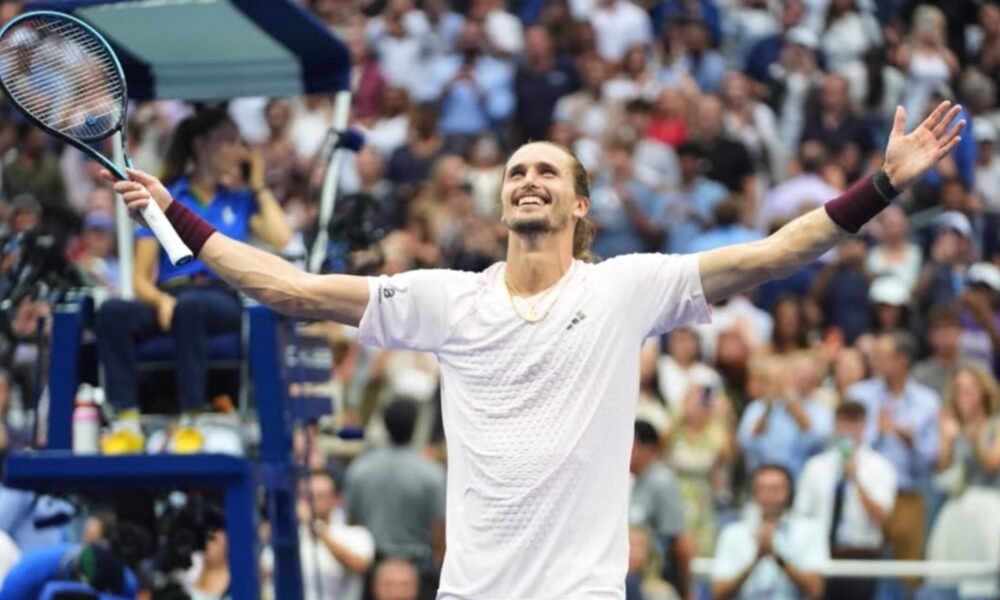
Zverev’s US Open win delivered a second Grand Slam title in 2026, while Ben Shelton’s defeat left American men’s tennis waiting again.
Zverev US Open Win Ends a Long Wait in New York
Alexander Zverev’s US Open win was so absorbing that he briefly forgot it had happened.
After serving out a 6–3, 7–6 (7–2), 5–7, 6–2 victory over Ben Shelton, the German returned toward the baseline as if another point were about to begin. His team quickly reminded him that the match—and the tournament—was over.
The unusual ending matched the larger story: Zverev stayed so focused on each point that he finally completed the breakthrough that had eluded him for years.
Zverev Stayed Calm as Shelton Tried to Rally
Shelton entered his first Grand Slam final with the support of a loud American crowd. He also arrived with a powerful serve, explosive movement, and momentum from his upset of Carlos Alcaraz in the quarterfinals.
Zverev responded by making the match uncomfortable rather than theatrical. He served accurately, kept rallies manageable, and waited for Shelton to make the kind of errors that often appear when a player is trying to force a final back into balance.
The German won the first set 6–3 and took the second in a tiebreak. Shelton finally found an opening late in the third set, breaking Zverev to stay alive. But the comeback lasted only briefly. Zverev broke at the beginning of the fourth set and regained control before closing out the title.
A Missed Scoreline Made the Finish Unforgettable
Zverev later explained that he thought the score was 5–1 when he hit the final serve. He did not realize the match was finished until he saw the reaction from his box.
The mistake may have helped him. Serving for a Grand Slam title can bring a wave of nerves, especially for a player who had once lost a US Open final after holding a two-set lead. Because Zverev believed the match was not yet over, he approached the point without the usual pressure associated with championship point.
He later joked that he might have served several double faults if he had understood the situation. Instead, he delivered the final shot and discovered that his long-awaited New York title was already secure.
The Victory Changes Zverev’s Career Story
For years, Zverev was described as one of the best players without a major championship. He had reached Grand Slam semifinals and finals, won Olympic gold, and established himself among the sport’s elite.
The results were impressive, but the missing major title shaped how his career was discussed. That changed in June when he won the French Open. His US Open triumph now gives him two Grand Slam titles in the same season.
The achievement also marks a dramatic turnaround from his 2020 US Open final loss to Dominic Thiem. In that match, Zverev led by two sets and served for the championship before Thiem rallied. Six years later, the German handled the closing stages with far greater control.
Shelton’s Power Wasn’t Enough
Shelton produced several of the match’s most memorable shots. His serve regularly reached more than 140 mph, and his athleticism allowed him to turn defensive positions into attacking opportunities.
But the American struggled to maintain that level. Double faults and loose forehands cost him important points, particularly early in the match and during the second-set tiebreak.
Zverev did not need to overpower him. He simply kept applying pressure and allowed Shelton’s inconsistency to do some of the damage. That is often the difference in a Grand Slam final: one player produces spectacular points, while the other wins more of the ordinary ones.
Shelton did recover in the third set, showing the resilience that carried him through the tournament. Yet after Zverev broke immediately in the fourth, the American could not recreate the same momentum. Fox News
America’s Grand Slam Wait Continues
Shelton’s defeat means an American man still has not won a Grand Slam singles title since Andy Roddick’s 2003 US Open championship.
That streak is especially striking because American men’s tennis has produced several promising players during the intervening years. Shelton’s run offered a major opportunity: he was playing at home, had defeated Alcaraz, and had reached the final with the crowd behind him.
He did not win the trophy, but the tournament still established him as a serious contender. At 23, Shelton has time to learn from the experience, improve his consistency, and return to another major final.
The next challenge will be turning a breakthrough run into a pattern. Reaching one final creates attention. Winning a Grand Slam requires repeating the performance under even greater pressure.
What Comes Next for Zverev
The Zverev US Open win places the German at the center of the men’s tennis conversation. He now has two major championships in 2026 and has strengthened his position behind the leading names in the rankings.
His next goal is likely consistency across the entire season. Injuries, younger rivals, and the demanding Grand Slam schedule will test whether this year represents a one-time surge or the start of a sustained period at the top.
For now, the result is clear. Zverev finally turned a career defined by near-misses into a season of major victories, while Shelton left New York with a painful loss—and evidence that he may be close to becoming America’s next Grand Slam champion.