Celebrity
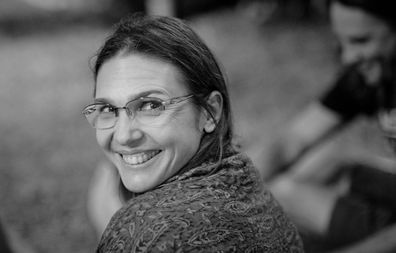
How to become a Marine Biologist: Daniela Ceccarelli shares what the career is really like | Exclusive interview

When Daniela Ceccarelli was eight years old, she moved from Italy to Syria.
It was there that she fell in love with the ocean.
At first it doesn’t make sense. Syria isn’t a place you immediately think of when you talk about marine life, but Ceccarelli tells nine.com.au it was coastal holidays with crystal clear waters lined with limestone cliffs that first sparked her passion.
“I just always sat in the water with my mask on,” she remembers.
She attended an international school at the time and explained that her principal “had a passion for nature.”

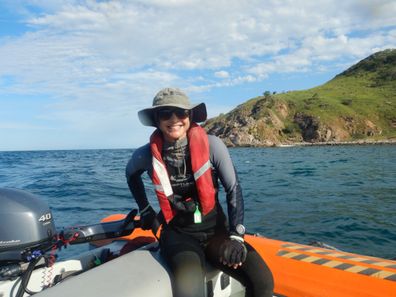
“He would gather the whole school together once a week for us to watch [David Attenborough’s] Life on earth,” she says
“I was about 10, 11, I think, and one of the episodes had divers in it, and I thought, ‘oh, that’s what I want to do.’
“And the desire to be in the water, to look at marine life, to understand the ocean and somehow be close to it, has never really left me.”
Ceccarelli later moved to Switzerland, a landlocked country with few opportunities to explore marine life. But she never gave up and eventually moved to Australia after graduating to study marine biology at James Cook University.
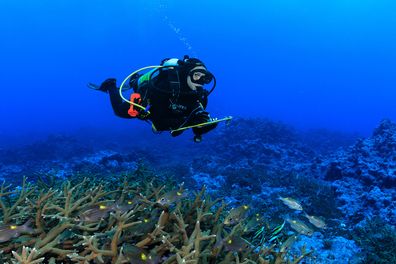
“I just wanted to be there; I wanted to be involved in studying and understanding the ocean,” she says.
“I wanted to be directly involved, not in a place where you write about it or in the lab or on the computer, but actually underwater, at the coal mine, really looking at things and trying to understand how things work and also trying to understand how we as people can make a difference in a positive way rather than always in a negative way.”
After earning her Bachelor of Science degree, Ceccarelli went on to pursue a master’s degree and received her PhD in 2004. Throughout almost all of her studies, she also raised two young children.
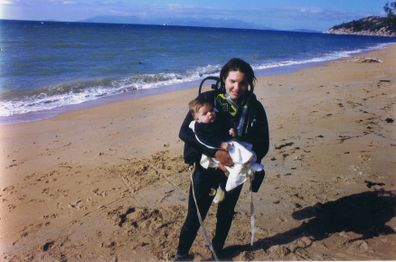
“From then on, I haven’t looked back. I just stayed as a contractor and worked independently from contract to contract,” she says, explaining that she wanted to work in a way that gave her the flexibility to spend time with her children.
Today she works at the Australian Institute of Marine Science (AIMS) as part of the long-term monitoring team, which she says has always been a “legendary program”.
“This is the largest, longest and most consistent dataset of coral reefs anywhere in the world, and so they have always been somewhat legendary. I am very happy to be part of this team,” she says.
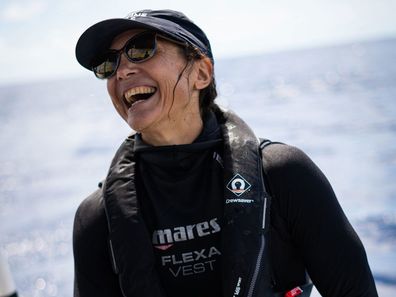
Although becoming a marine biologist is the dream of many young people in Australia, Ceccarelli remembers it as a “bizarre” idea when she was growing up.
”It was like, ‘What? Is that even a job?’ No one had heard of it,” she says.
And while many think it’s simply swimming with dolphins, Ceccarelli says that’s only partially the truth.
“My day can consist of two things. When I’m on dry land, I spend part of my days at the AIMS headquarters in Townsville… I’m basically sitting at my computer. Not exactly glamorous at all,” she explains.
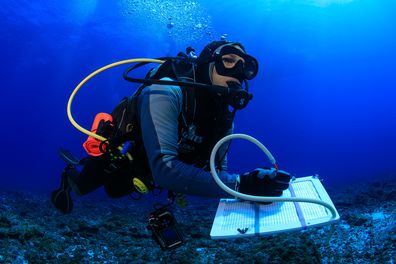
“But what I would do is look at the data that we collect. So look at numbers and basically apply statistical techniques that allow those numbers to tell a story.”
On the other end of the spectrum, Ceccarelli spends about 120 days a year on a boat.
“My team would typically do three-week trips, so three weeks in a row where we might not touch land,” she says.
“We’re basically just handed a schedule. This is when you go to sea. And then our lives revolve around that schedule during the year.”
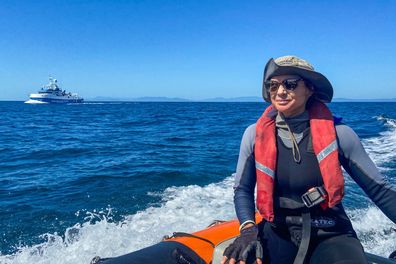
Each day at sea begins with a morning meeting where the trip leader will draw up the plan for the day before everyone gets ready to enter the water.
Ceccarelli and her team are then transferred to two smaller boats and start the day with a process called “manta tow.”
“We basically let the skull drag along while holding on to a board, and we give very quick scores to the coral and some fish,” she explains.
“The boat goes for two minutes, and after two minutes it stops, and we write things on the board with our pencil, and then the boat goes again.
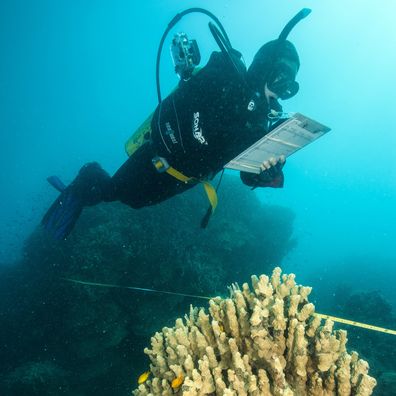
“We do that until we’ve walked the entire perimeter of the reef… that usually takes about two hours.”
Every year, Ceccarelli and her team go back to the same places to measure the difference from year to year.
After donning their diving gear, Ceccarelli and her team lay out measuring tapes to make sure they cover the same area before using them to swim and measure the amount of coral and fish.
“I’m on the fishing team, I’m trained to know the names of all the fish,” she explains.
“So I swim along and count the fish, literally. I have to write down their names in Latin and how many there are, and I also have to estimate their size so that we can get a pretty good idea of how long the fish are.”
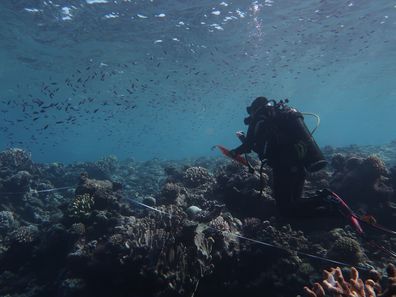
We spend most of the rest of the day in the water, recording measurements on special underwater paper, before returning to the boat to record their findings.
While it may not exactly be swimming with dolphins, this is probably the closest you can get in a professional sense.
In collaboration with AIMS, Ceccarelli explores the Great Barrier Reef, but her previous work took her beyond the Reef to the Coral Sea, which she describes as ‘the middle of nowhere’, as well as places like Tonga, the Marshall Islands and Tuvalu – the latter of which ultimately resulted in a career highlight over a decade later.
“While I was still consulting in 2010, I got a contract to go to Tuvalu and do some research on the fish on the reef. So what I did for AIMS was I swam along and counted the fish,” she recalls.
‘And we wrote a major report for the government of Tuvalu. Last year I was invited back to Tuvalu by National Geographic’s Pristine Seas group because they found my work online.
“So last year I ended up on the National Geographic boat all the way out in the Pacific Ocean, which was amazing. That was probably a highlight of my career.”
Produced in collaboration with CareerOne.