Technology
Roman Space Telescope Launch: 7 Bold NASA Mission Goals
NASA’s Roman Space Telescope is now in space. Learn how its wide-field camera will map galaxies, study dark energy, and search for distant planets.
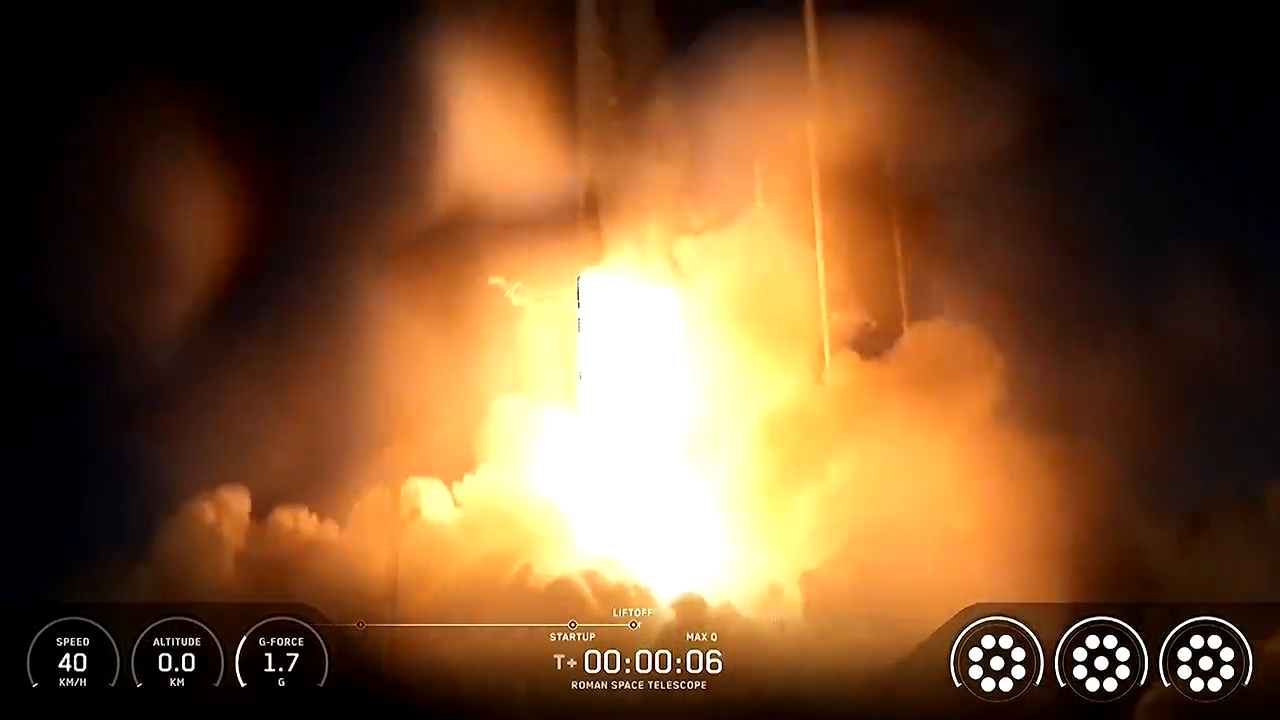
NASA’s Nancy Grace Roman Space Telescope has launched on a SpaceX Falcon Heavy rocket, beginning a journey toward an orbital position roughly 1 million miles from Earth. The observatory is designed to investigate dark energy, dark matter, exoplanets, and the large-scale structure of the universe.
Contents
- 1. Roman Space Telescope Reaches Space After Successful Launch
- 2. What Will the Roman Space Telescope Study?
- 3. How Roman Differs From Hubble and Webb
- 4. Roman Could Find Thousands of New Exoplanets
- 5. The Telescope’s Coronagraph Will Block Starlight
- 6. Roman Will Create a Giant Map of the Universe
- 7. Who Was Nancy Grace Roman?
- 8. How Long Will the Mission Last?
- 9. Why the Launch Matters
- 10. Final Takeaway
Roman Space Telescope Reaches Space After Successful Launch
The Roman Space Telescope lifted off from NASA’s Kennedy Space Center in Florida on Sunday, August 30, 2026, at approximately 7:26 a.m. Eastern Daylight Time.
A SpaceX Falcon Heavy carried the observatory into orbit. The launch marked only the 13th flight of the powerful rocket, which uses three core stages and nine Merlin engines on each stage. Yahoo
The telescope separated from the rocket about 31 minutes after liftoff. Its solar panels then deployed, allowing the observatory to begin the next stage of its mission.
The spacecraft is now traveling toward Sun–Earth Lagrange Point 2, known as L2. That location sits approximately 1 million miles, or 1.6 million kilometers, from Earth.
What Will the Roman Space Telescope Study?
The Roman Space Telescope was built to examine some of astronomy’s most difficult questions.
Scientists want to understand why the universe’s expansion is accelerating, what dark matter is made of, and how galaxies have changed over cosmic time. The mission will also search for planets outside our solar system.
Its primary scientific goals include:
- Mapping billions of galaxies
- Measuring the effects of dark energy
- Charting the distribution of dark matter
- Testing gravity across enormous distances
- Discovering exoplanets
- Studying distant supernovae
- Observing temporary cosmic events
The observatory’s wide field of view will allow researchers to examine enormous areas of sky far more efficiently than earlier space telescopes.
Dark Energy and the Expanding Universe
The universe has been expanding since the Big Bang, which occurred approximately 13.8 billion years ago. In 1998, astronomers discovered that this expansion is accelerating.
Scientists use the term dark energy for the unknown force believed to drive that acceleration. Although dark energy appears to make up most of the universe’s energy budget, researchers still do not know what it actually is.
The Roman Space Telescope will investigate dark energy by studying the distribution and movement of galaxies over time. It will also observe supernovae and use weak gravitational lensing to track how matter shapes the universe.
The resulting data could test whether the current standard model of cosmology accurately describes reality.
How Roman Differs From Hubble and Webb
The Roman Space Telescope is not intended to replace the Hubble Space Telescope or the James Webb Space Telescope. Instead, it will provide a different type of observation.
Hubble produces sharp images across visible, ultraviolet, and some infrared wavelengths. Webb specializes in highly sensitive infrared observations, allowing it to study distant galaxies and objects hidden behind clouds of dust.
Roman will act more like a wide-angle astronomical camera. Its mirror is similar in size to Hubble’s, but its field of view will be much larger. That means Roman can survey broad regions of the sky quickly, while Hubble and Webb can investigate individual targets in greater detail.
NASA scientists have compared the difference to camera lenses: Webb offers a deep, zoomed-in view, while Roman provides a sweeping panoramic perspective.
A Faster Way to Survey the Milky Way
One of Roman’s advantages is speed. NASA scientists estimate that Roman could survey the entire Milky Way in about one month. A comparable survey would take Hubble roughly a century. Yahoo
That ability matters because astronomical discoveries often depend on observing huge numbers of stars and galaxies. A wider survey increases the odds of finding rare objects, unusual events, and patterns that smaller observations might miss.
Roman Could Find Thousands of New Exoplanets
The Roman Space Telescope will search for exoplanets, which are planets orbiting stars beyond the Sun.
One method involves watching stars for tiny changes in brightness. When a planet crosses in front of its star from the telescope’s viewpoint, the star briefly dims. Astronomers can use those repeated changes to estimate the planet’s size and orbit.
Roman will also use gravitational microlensing. This technique detects a planet when its gravity bends and magnifies light from a more distant star.
The mission could identify tens of thousands of exoplanets, including planets that are difficult to detect using other methods. Researchers hope the survey will improve scientists’ understanding of how planetary systems form and evolve.
Searching for Planets in the Galactic Bulge
Roman’s microlensing survey will focus partly on the dense central region of the Milky Way. That area contains enormous numbers of stars, creating many opportunities for brief gravitational-lensing events.
The survey could reveal planets that orbit far from their stars, including worlds that would be hard to find through the transit method. It may also detect planets that have been ejected from their original systems and now drift through interstellar space.
These discoveries could expand the known range of planetary systems beyond those resembling our own.
The Telescope’s Coronagraph Will Block Starlight
Roman includes a technology demonstration known as a coronagraph. The instrument is designed to suppress the intense glare of a star so astronomers can study much fainter objects orbiting nearby.
The system uses specialized optics and deformable mirrors that can adjust their shape. By controlling unwanted light, scientists hope to analyze reflected light from large exoplanets.
The coronagraph will not immediately produce a complete census of Earth-like planets. Its early purpose is to test technology that future missions could use to directly image smaller, potentially habitable worlds.
That makes the Roman Space Telescope important not only for its immediate discoveries but also for the development of future planet-hunting observatories.
Roman Will Create a Giant Map of the Universe
The telescope’s wide-field camera is expected to survey more than 2 billion galaxies during its main mission. It could also catalog roughly 20 billion stars and record tens of thousands of supernova explosions.
Those observations will help scientists build a three-dimensional map of the universe.
A map of that scale can reveal:
- How galaxies are distributed
- Where dark matter is concentrated
- How cosmic structures developed
- Whether dark energy has changed over time
- How gravity behaves across vast distances
The Roman Space Telescope may also detect transient events, including stellar flares and stars disrupted by black holes.
The Value of Unexpected Discoveries
Astronomers cannot predict every discovery a major observatory will make. Hubble and Webb both produced important findings beyond the missions’ original headline goals.
Roman’s large survey area increases the chance of finding rare or unfamiliar phenomena. Scientists expect it to identify objects that would be difficult to detect through targeted observation alone.
That discovery potential is one reason researchers describe Roman as a mission capable of changing astronomy in unexpected ways.
Who Was Nancy Grace Roman?
The observatory is named after Nancy Grace Roman, NASA’s first chief astronomer and one of the agency’s earliest female executives.
Roman helped establish NASA’s space astronomy program and advocated for the development of the Hubble Space Telescope. Her work earned her the nickname “Mother of Hubble.” She died in 2018 at the age of 93. Yahoo
Her career was shaped by a determination to study mathematics and science despite social expectations that discouraged women from pursuing technical fields.
Naming the new observatory after Roman recognizes both her scientific contributions and her role in creating the institutional support needed for space-based astronomy.
How Long Will the Mission Last?
NASA has planned the Roman Space Telescope’s primary mission for five years. The spacecraft may carry enough fuel to operate for an additional five years, depending on how much propellant is used during its journey and scientific operations. Yahoo
Before observations begin, engineers must complete a commissioning period. They will unfold and test the telescope, calibrate its instruments, confirm its pointing accuracy, and verify that the systems operate as designed.
That process is essential. Even a small optical or mechanical problem can affect observations made from millions of miles away.
Why the Launch Matters
The Roman Space Telescope fills a gap between narrow, detailed observations and broad astronomical surveys.
Hubble and Webb can reveal extraordinary detail, but they generally examine smaller portions of the sky. Roman will scan much larger regions, creating a statistical view of the universe that complements the work of both telescopes.
Its findings could help answer questions that have resisted explanation for decades:
- What is dark energy?
- How is dark matter distributed?
- Do current theories of gravity work across cosmic distances?
- How common are planetary systems?
- How did galaxies assemble and evolve?
- What rare events are taking place throughout the universe?
The mission’s launch also demonstrates the growing role of commercial rockets in transporting major NASA science payloads. SpaceX’s Falcon Heavy provided the lift needed to send the observatory toward its distant operating location.
Final Takeaway
The Roman Space Telescope has begun a five-year mission to survey the universe on an enormous scale.
By mapping billions of galaxies, studying dark energy and dark matter, searching for exoplanets, and testing new imaging technology, the observatory will complement—not replace—the work of Hubble and Webb.
Its most important discovery may be something scientists already expect. But the mission’s broad view of the cosmos could also reveal an entirely new phenomenon, changing what researchers understand about the universe and humanity’s place within it.