News
Newly created Polymarket accounts bet big on US-Iran ceasefire hours before Trump’s announcement
Early in the day, Trump had warned on social media that “an entire civilization will die tonight” if Iran does not meet his demand to open the Strait of Hormuz before his 8 p.m. ET deadline.
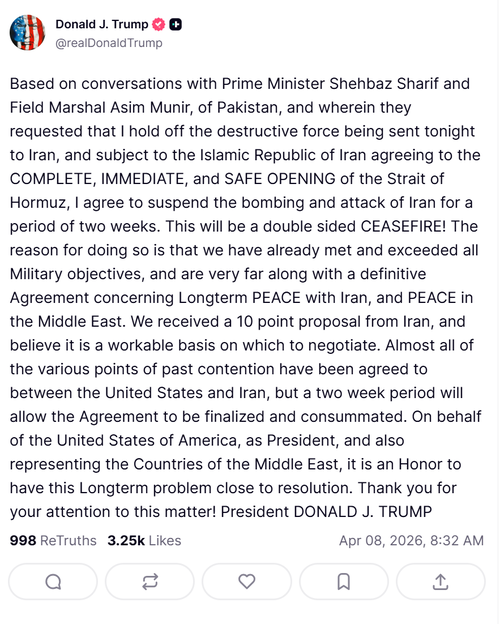
An analysis of publicly available blockchain data from Polymarket, using crypto analytics platform Dune, shows that at least 50 accounts, or wallets, placed substantial “Yes” bets on Tuesday before Trump announced the ceasefire in a Truth Social post around 6:30 PM ET.
These were the first bets made by these particular wallets.
One of these wallets, which was created around 10 a.m. local time on Tuesday, placed approximately $72,000 ($102,264) in bets at an average price of 12.50 cents.
The buy-in for each betting event ranges from $0 to $1.42, which reflects a 0 to 100 percent chance of what users think might happen.
This Polymarket user then cashed out for a profit of $284,032.
Another, who joined the platform on April 6 and traded on this exact event, shows a profit of $178,230.
Another wallet, created 12 minutes before Trump’s post, made $45,314 in “Yes” bets at 50 cents, and is estimated to have made a profit of $68,877.
The higher price for “Yes” at that time may have reflected the Pakistani government’s efforts late Tuesday to get Trump to extend his deadline by two weeks.
There is also the possibility that these individual Polymarket users had placed their bets expecting Trump to back down, given his habit during his second term of making bold threats only to back down — a phenomenon his critics have derided as “Trump Always Chickens Out,” or TACO.
While some users have made handsome profits, others are having to wait for payouts as Polymarket labeled the April 7 Iran-US contract as ‘disputed’ as Iran continued to impose restrictions on ships transiting the Strait of Hormuz and missile attacks in the region continued.
It may take up to 48 hours for the dispute to be resolved.
Public blockchain data cannot identify who controls the new wallets. Polymarket uses proxy smart contract wallets, which means one user can create multiple accounts.
Only Polymarket has the internal data necessary to determine whether these were new users or existing users opening additional accounts.
Polymarket did not respond to a request for comment.
Rep. Blake Moore, R-Utah, who has introduced legislation to regulate prediction markets, released a statement Wednesday saying, “It is highly unlikely that these are good faith transactions; it is far more likely that these are insiders who have access to information before the public. Without some form of restrictions, there is nothing to stop government or military officials from profiting from their positions.”
The trading pattern of newly created Polymarket accounts placing strategic, well-timed bets mirrors previous episodes on the platform.
Newly created accounts placed big bets hours before the January jailing of Venezuelan President Nicolás Maduro, making hundreds of thousands of dollars in profits.
Similar clusters of accounts have also repeatedly profited from well-timed bets on military actions involving Iran.
Such bets have repeatedly raised questions among the public and members of Congress about whether some traders are using insider information to make profits in these prediction markets.
Bipartisan groups of senators and representatives have introduced legislation that would broaden the definition of insider trading to include prediction markets.
Even the two largest platforms in the industry, Kalshi and Polymarket, have said they see the need to broaden the definition of insider trading on their platforms.
“This is why these markets need regulation,” said Todd Philips, a professor at Georgia State University who has written about prediction markets and the industry’s regulation.
“We can’t have people trading with insider information and expecting other traders to be fine in these markets.”
NEVER MISS A STORY: Be the first to receive your latest news and exclusive stories by following us on all platforms.