News
US says it’s hunting for explosive mines in latest push to open the Strait of Hormuz
The search for underwater explosives could take months despite a tenuous ceasefire between the United States and Iran during the weeks-long war, experts say.
Any future claims that the U.S. has cleared the waterway through which 20 percent of the world’s oil normally passes may not convince commercial freighters and their insurers that it is finally safe.
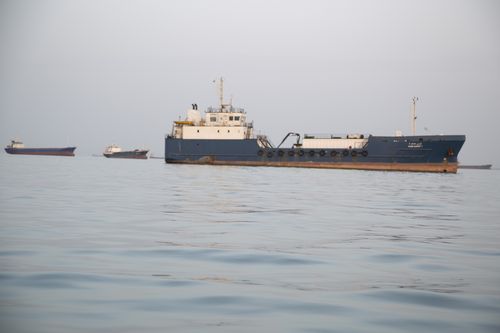
“You don’t even have to have laid mines — you just have to make people believe you’ve laid mines,” said Emma Salisbury, a scholar at the Foreign Policy Research Institute.
“And even if the US crosses the strait and says everything is clear, all the Iranians have to say is, ‘Well, actually you haven’t found them all yet,’” said Salisbury, who is also a fellow at the Royal Navy Strategic Studies Centre.
“There is only so much the U.S. can do to return that confidence to commercial shipping.”
The search for mines is one of the latest tactics announced by the Trump administration to get traffic flowing through the strait again as rising energy prices and broader economic fallout pose a political risk.
The US has also blockaded Iranian ports and seized ships linked to Tehran, but the president said on Saturday he had instructed his envoys not to travel to Pakistan for the latest ceasefire talks after Iran’s top diplomat left Islamabad.
Hegseth does not deny that mine clearance can take six months
Pentagon officials told lawmakers it would likely take six months to clear the mines that have troubled Iran, according to a person familiar with the situation who spoke on condition of anonymity to discuss the sensitive information.
The information was provided during a classified briefing in the House Armed Services Committee on Tuesday.
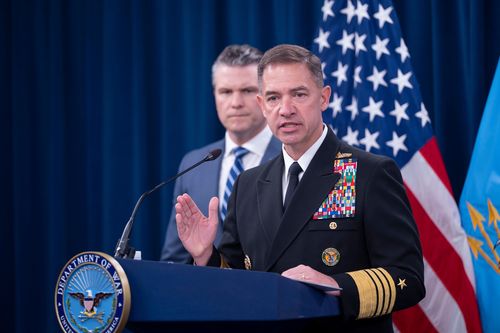
When asked about the estimate, Defense Secretary Pete Hegseth told reporters Friday that the military would not speculate on a timeline, but he did not deny it.
“That was reportedly something that was said,” Hegseth said at a Pentagon news conference. “But we are confident that in the right time we can clear all the mines we identify.”
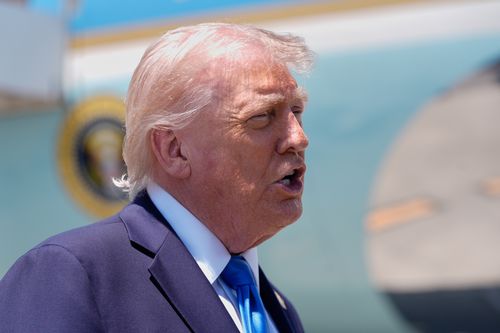
Trump said he has ordered the Navy to attack any boat that lays mines in the strait.
“In addition, our ‘mine sweepers’ are currently clearing the Strait,” the president said on social media on Thursday. “I hereby order that this activity be continued, but at a tripled level!”
Admiral Brad Cooper, the top U.S. commander in the Middle East, recently told reporters that the military would work to clear mines from the strait. He did not provide details.
There is no evidence that the US military is now using warships, the most visible means of mine clearance, in the strait.
But the Navy also has divers and small teams of explosive ordnance disposal technicians in the region capable of clearing mines. They are a less obvious target than a large warship.
Experts also say some mine clearance equipment could be moved from ships and deployed from land.
It is easier for Iran to lay mines than to find them, an expert says
It is unclear whether one mine was deployed. Iran has only mentioned the “likelihood” of mines on the pre-war routes of the strait.
Estimates of Iran’s mining reserves are in the low thousands, says Salisbury of the Foreign Policy Research Institute. Most underwater explosives are believed to be older Soviet models. Some of the newer ones may come from China or be made domestically.
“Laying mines is a lot easier than sweeping mines, so you can literally push these things off the back of a speedboat,” Salisbury said, although she noted that the U.S. could probably see that.
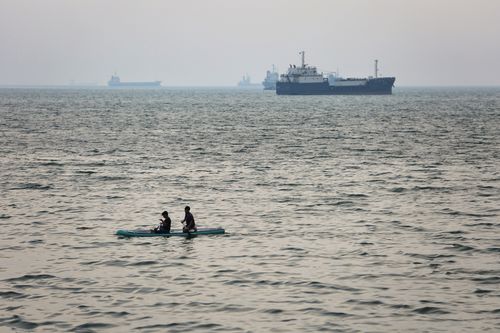
Iran also has small submarines that can lay mines and are much harder to detect, Salisbury added. She said she has seen no evidence that they were destroyed in the war.
If Iran has planted mines in the strait, they are not the spiky balls floating on the surface like you see in movies, Salisbury said.
The explosives are likely on the seabed or tethered to it and floating below the surface. They can be caused by the water pressure that changes as a ship passes or by the noise of the engine.
How the US can detect mines in the straits
The U.S. Navy now has two littoral combat ships in the Middle East that can detect mines, said a defense official, who spoke on condition of anonymity to discuss sensitive military moves.
Two American Avenger-class minesweepers based in Japan also headed to the Middle East but were in the Pacific Ocean as of Friday, the official said.
Steven Wills, a retired lieutenant commander who served on an Avenger-class ship, said the Navy is likely looking for naval explosives to create a safe channel through the strait.
Minesweeping is a slower process that usually takes place after a conflict.
“Mine hunting is walking around your yard and pulling individual weeds and dandelions so you can walk safely from one side to the other. Minesweeping is more like mowing the lawn,” says Wills, an expert at the United States Navy League’s Center for Maritime Strategy.
Scott Savitz, a researcher at the RAND Corp. which focuses on naval operations and mine clearance, said the Navy does not necessarily need to remove every last mine.
“There are still areas that have not been cleaned up from the Second World War – and in some cases the First World War – just because they are so resource intensive and take a lot of time,” he said.
Teams on the Navy’s littoral combat ships can deploy remotely operated, unmanned vehicles that use sonar and other technology to find mines, Wills said. They also carry charges to destroy the explosives.
U.S. Navy ships may also have explosive ordnance disposal teams, including divers, that can detect and destroy mines, Wills said. Helicopters can search for mines with lasers.
Shipping companies weigh the risks
Ultimately, shipping companies will be willing to take risks to travel through the strait, “especially considering how lucrative it is,” Savitz said.
According to Iran’s approval procedure for ships wishing to pass through the strait, ships must take a different route than before the war: north, near the Iranian coastline.
Insurers are adding a clause requiring ship owners to contact Iranian authorities to ensure safe passage, says Dylan Mortimer, British naval war chief for insurance broker Marsh.
That certification does not specifically mention mines and is intended to protect against the entire spectrum of threats, including missile and drone attacks or seizures, Mortimer said.
But mines play at least a psychological role, a phenomenon Mortimer called the “specter of menace.”
“That plays to the advantage of the Iranians because whether there are mines or not, people think there are mines and will act accordingly,” Mortimer said.
This fear could mean it will take longer to restore confidence that the strait is safe even after the war.